BrainState-ML: Deciphering Cognitive Assessment Performance and Brain Functional Organization from Task-fMRI Using Interpretable Machine Learning
Embedded Research Paper PDF Reader
Open PDF in New Window →Paper Abstract
Task-based functional magnetic resonance imaging (fMRI) provides a means of examining how cognitive states are represented through distributed brain activation patterns. This paper presents an interpretable machine learning framework for decoding cognitive task states from task-fMRI contrast maps using the Brainomics Localizer dataset. The analysis includes 30 participants and four cognitive task categories: Working Memory / Math, Language / Reading, Motor Control, and Visual Processing. Each three-dimensional contrast map is transformed into a 100-dimensional regional activation vector using the Schaefer 2018 cortical atlas, enabling compact and interpretable representation of task-evoked cortical activity. Experimental results show that Random Forest achieves the highest classification accuracy of 85.83%, while Logistic Regression achieves comparable accuracy of 85.00% and the highest macro AUROC of 0.9656.
High-Resolution Paper Figures
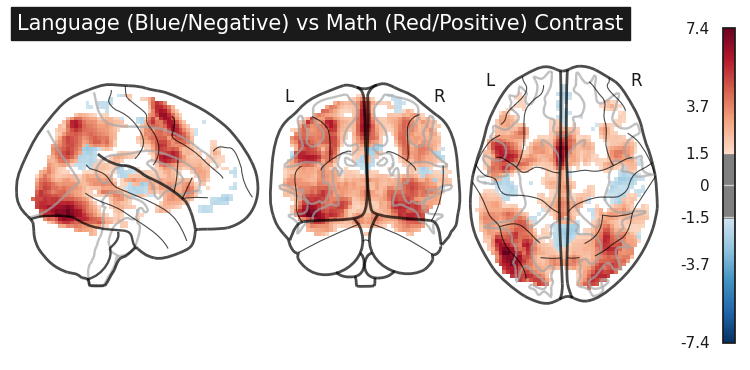
Figure 1: Project Pipeline
Group-level contrast map comparing language and mathematical cognition conditions.
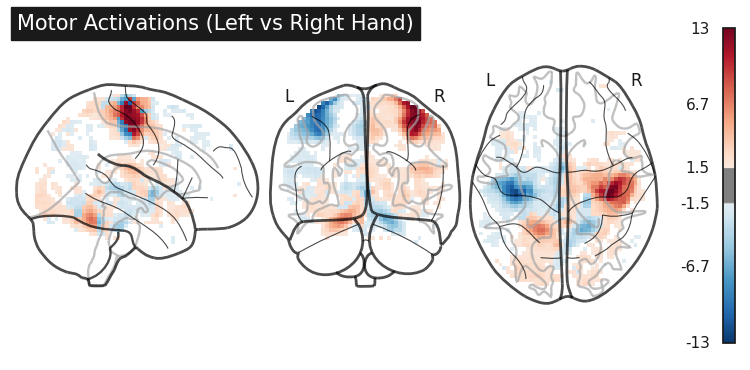
Figure 2: Motor Contrast Map
Group-level activation map for motor control based on left vs right hand contrast.
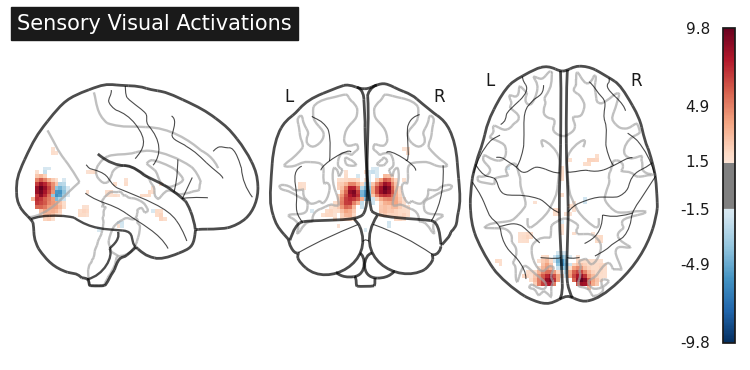
Figure 3: Visual Processing Map
Group-level activation map for sensory visual processing.
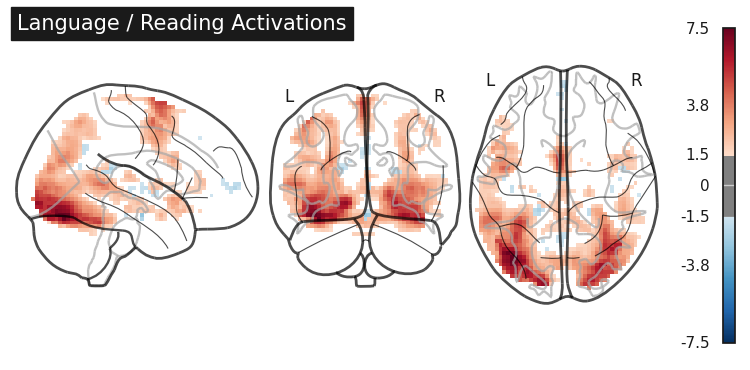
Figure 4: Language Reading Map
Group-level activation map for sentence reading condition.
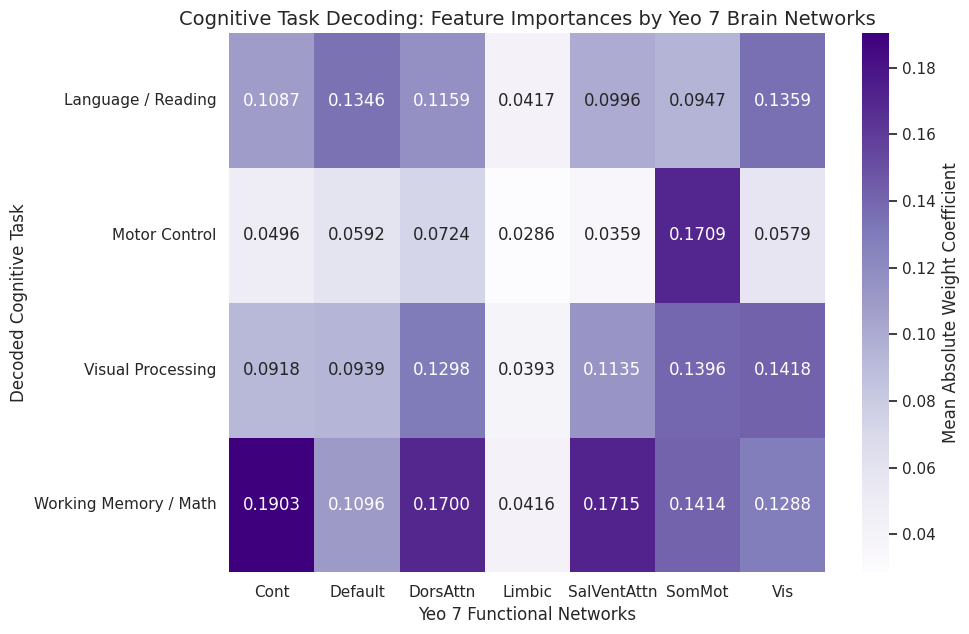
Figure 5: Yeo 7 Feature Importance
Yeo seven-network feature-importance profile for cognitive decoding.
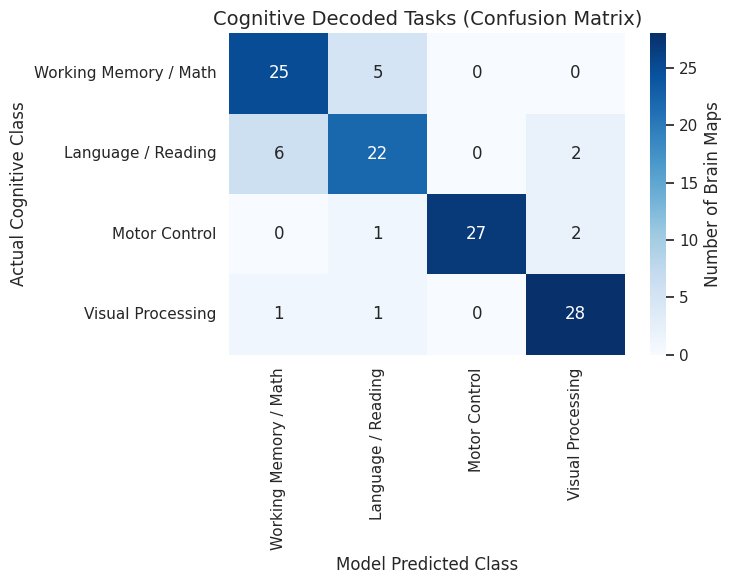
Figure 6: Best Model Confusion Matrix
Confusion matrix for the best-performing classifier.